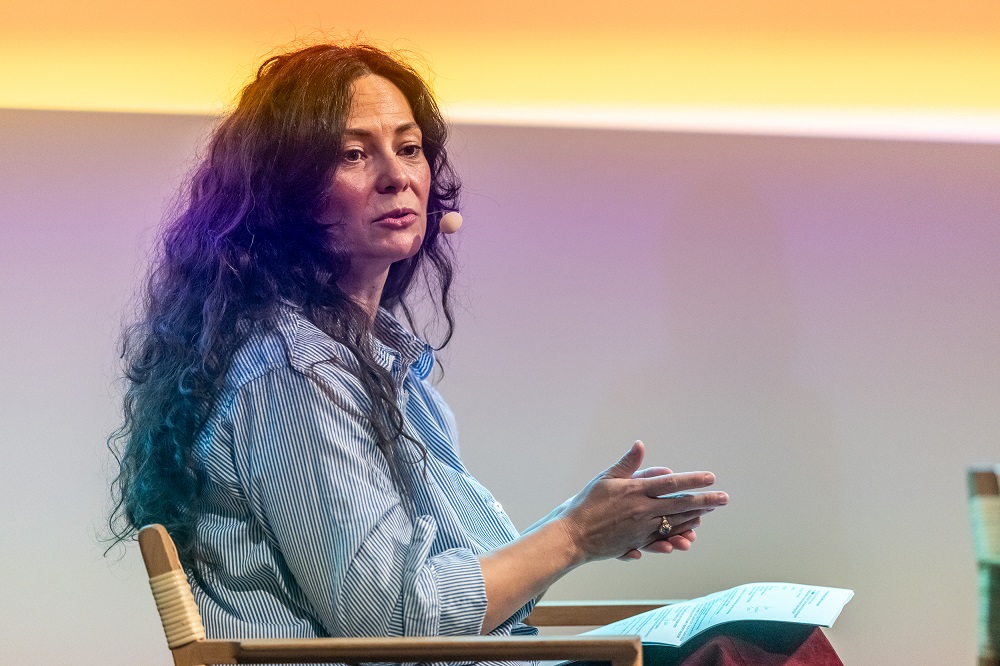
Q&A: Carolina Echeverri, MXD
Q&A med Carolina Echeverri, senior advisor på Internationale Projekter hos Music Export Denmark, MXD. Carolina holdt oplæg på Autors konference Besat Af Musik 1. november 2025. I vores særnyhedsbrev Frekvens indgår også et interview med Carolina. I den forbindelse bringer vi her alle spørgsmål og svar om musikeksport for musikskabere til Carolina på engelsk.
Q&A with Carolina Echeverri, Senior Advisor – International Projects, MXD (Music Export Denmark).
Why is it a good idea for Danish musicians to branch out internationally?
Every artist’s path is different, so it’s not the right move for everyone. But for those who choose to do it, going international can add real longevity to a career. It’s one of the most organic ways to grow your audience, open new opportunities – whether through touring, writing, composing, or synch – and connect with people around the world.
Today, music can be heard globally with just one click. That means your biggest supporters might not be in Denmark at all – they could be in the UK, Italy, Mexico, or South Korea. Expanding internationally gives them the chance to follow and support you throughout your career.
It’s not only about financial opportunities. Crossing borders also brings artistic inspiration and valuable collaborations that can shape your music in new ways.
If I’m a Danish artist wanting to branch out internationally. What are the first steps, and what do artists often forget?
There’s no single formula – every artist’s journey is unique. The one common thread we see is persistence and patience. If you want a long-term career abroad, those two qualities are essential.
That said, one of the best first steps is to find the right partners. You don’t need many – just one or two who truly believe in your project. A strong agent, label, or manager is often worth more than a big marketing budget, because in today’s saturated music world, curatorship and strategy are everything.
How do you find them? Start with research. Look at artists you feel connected to, see who their booking agents, publicists, or promoters are, and map out potential partners. Don’t focus on huge stars – their teams are usually out of reach. Instead, look at artists who are just beginning to gain momentum and whose scenes feel authentic to you.
Once you have some direction, showcase festivals are a good entry point for networking. For beginners, SPOT (DK), by:Larm (NO), or Tallinn Music Week (EST) are great. If you’re aiming further, Iceland Airwaves bridges the US and European markets. Bigger showcases like The Great Escape (UK) and Eurosonic (NL) can be valuable, but they’re best tackled with an existing partner to guide you through the sheer number of delegates.
Showcase festivals aren’t always the most enjoyable concerts to play, but they can be very effective if you’re well-prepared.
A word of caution: SXSW (US) is famous, but unless you already have a strong US team in place, it often results in high costs and little payoff.
Finally, two roles artists sometimes overlook: promoters and publicists. A publicist is not just there to get you reviews – they shape your story for the world, so make sure your biography, visuals, and vision are aligned with them. Promoters, meanwhile, take financial risks to put on your shows. Treat them as true partners – communicate openly, support your shows, and build trust for long-term collaboration.
Does strategy change depending on the country or genre?
Yes. While streaming has opened the world, cultural differences still matter.
- Japan: Loves niche and specialized artists – vinyl editions, deep artistry, and unique concepts thrive here.
- UK, US, France, Germany: Strong markets for rock bands.
- South Korea: A hub for pop and experimental pop writers; many Danish songwriters are already active in K-pop.
But it’s not just about genre – it’s also about culture. In Asia, for example, publishing deals look different, negotiations are less aggressive than in the UK or US and communicating in the local language matters. Similarly, Spotify isn’t dominant everywhere – Japan uses different platforms.
Closer to home, France can feel like a closed market, but in reality, audiences there value high artistry and strong storytelling across genres. The UK, on the other hand, is dynamic and exciting but also one of the toughest, most competitive markets – requiring patience, resilience, and often greater financial investment.
The key is to match your artistic, emotional, and financial resources with the right market.
Are some countries easier for Danish artists to break into?
Not necessarily – it depends on your music and your network. That said, Germany and the UK are common first steps. Germany is financially accessible and easy to tour, while the UK connects you to English-speaking markets and can act as a springboard to the US.
But don’t overlook the Netherlands and Belgium – both are easy to tour, have subsidized venues that pay fair fees, and are close to Germany and France. In France, smaller cities often offer better fees and less competition than Paris, even though most artists head straight there.
For songwriters and producers, South Korea is currently strong, with Japan’s J-pop market increasingly attractive as well. These markets can often be developed remotely, making them more accessible than touring markets.
What is your best advice for Danish musicians aiming for an international career?
You can absolutely do it. But don’t rush in without a plan. Jumping too soon can be financially draining, emotionally exhausting, and potentially damaging to key relationships.
Instead:
- Do your research.
- Focus on one market at a time.
- Connect with both fans (through a strong publicist and online presence) and industry professionals who fit your artistic vision.
- Use showcase festivals to start building your network.
- Approach people with genuine interest – not just because you need something.
Despite its challenges, the music industry is still built on passion. Kindness, empathy, and authenticity go a long way. And encouragingly, the industry is shifting toward more diverse, supportive professionals on both the artist and business side. Being part of that trend will help shape the future.
How should musicians define success internationally?
Success looks different for everyone. Even within the same band, each member might have a different definition.
For me, after more than 20 years in the industry, success is simple: when people ask you back. Whether it’s for a new show, a collaboration, or a new release – if people want more of what you offer, that’s success.
And it’s rarely about one big break. More often, it’s a series of smaller steps that build momentum over time. Success also comes and goes – it’s not static. Many careers are built on organic, steady growth rather than overnight breakthroughs.
From the outside, it can look like an artist suddenly appeared, but usually there are years of work behind that moment. The artists who last are the ones who grow gradually and sustainably, supported by authentic careers and committed teams.
About Carolina Echeverri
About Carolina Echeverri
Carolina Echeverri is Senior Advisor for International Projects at MXD – Music Export Denmark. Born in Colombia, she studied International Business and Economics at the Amsterdam Business School before joining ANTI/Epitaph Records in Amsterdam, where she worked with artists such as Tom Waits, Bad Religion, Converge, and Mavis Staples, eventually leading the European Marketing & PR team.
In 2011, she moved to Copenhagen to lead international development at Volcano Management (Kashmir, WhoMadeWho, The Floor is Made of Lava), later co-founding Skyway Management and co-representing artists including Broken Twin and WhoMadeWho. She has also taught Entrepreneurship and Cultural Business Studies at Rytmisk Musikkonservatorium (RMC).
Today, alongside her role at MXD, Carolina serves on the board of Another Life and oversees strategic projects and global initiatives for the Danish music industry, in collaboration with NOMEX (the Nordic export offices), the Ministry of Culture, and the Danish Agency for Culture and Palaces.
MXD’s mission is to promote Danish music internationally by strengthening global visibility, expanding networks, and fostering collaborations between Danish artists, companies, and international partners.